
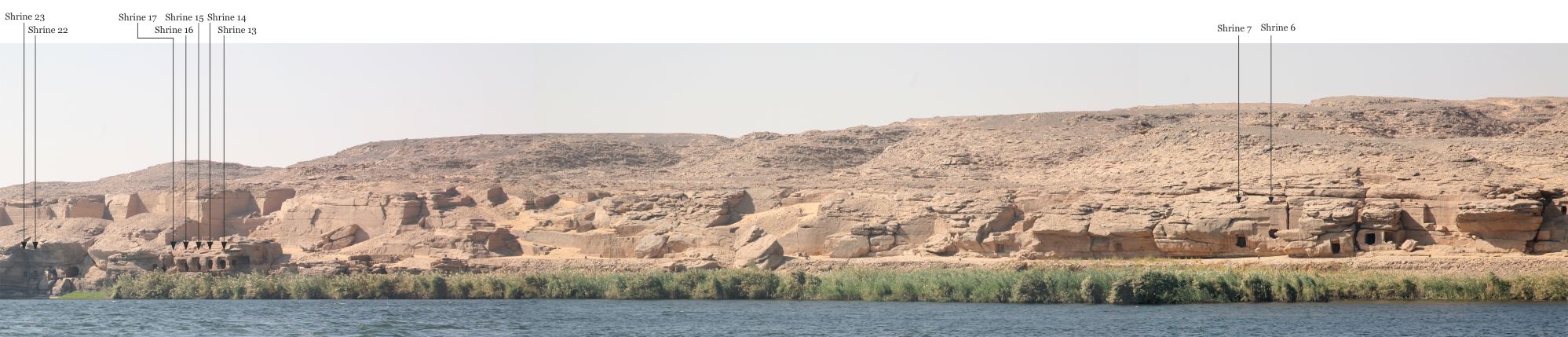
The row of shrines was situated on the west bank by the river, the shrines were cut in the rock just above the water line. In some cases the access to the shrines was possible from the land, although some of them (nos 12-23) were accessible only from the river.
Thirty-two shrines were cut in these parts of the rock which remained after quarrying was completed. Shrines nos 12-17 are visibly related spatially. The biggest group can be dated to the co-regency of Hatshepsut and Thutmose III, two come from the time of Thutmose I, one was hewn during the regency of Hatshepsut and the rest of the group were constructed between the sole reign of Thutmose III and the reign of Amenhotep III. The last three can be dated to the period of the late 18th dynasty. The reason for their construction was studied by L. Delvaux,[1] A.-Ch. Thiem,[2] M. Bommas[3] and lately by A. Kucharek and the latter defined the shrines as "a royal favor consisting of an offering and memorial cult placed in an area sacred to the life-giving inundation".[4]
Typical shrine had a single room with the entrance facing the river. The decoration of shrines was standardised.[5] The door frames were decorated with the royal titulary on the lintel and offering formula giving the name and titles of the owner on the jambs. The ceiling of the chamber was usually flat, only sometimes vaulted and decorated in patterns known from tombs. The scenes on the parallel walls represented offerings before the owner sitting in front of the offering table. In some cases they were enriched with additional details, such as offering bearers, musicians and dancers approaching the offering table and the family members shown below the owner. The inner east wall was decorated with the representation of the owner praising Amun-Ra on the north side and Ra-Horakhte on the south side. A niche or even a small room designed for the seated statue of the owner of the shrine and the statues of his relatives was cut in the rear, west wall.
Judging by the representations, in the times of Hatshepsut the main gods venerated in Gebel es-Silsilah were Sobek, Lord of Kheny[6] and Amun-Ra,[7] in the chapel of Sen-en-mut the Triad from Elephantine appeared twice.[8]
Footnotes
- ^ 434: Hatshepsout et le Gebel es-Silsileh: les carrières d'une reine dangereuse - - - Delvaux, Luc.
- ^ 471: Speos von Gebel es-Silsileh - Harrassowitz Verlag - 2000 - Thiem, Andrea-Christina.
- ^ 437: Schrein unter. Gebel es-Silsilah im Neuen Reich - - - Bommas, Martin.
- ^ 420: Gebel el-Silsila, 2012 - - - Kucharek, Andrea.
- ^ 41: Gebel es-Silsilah. I. The Shrines - - 1963 - Caminos, Ricardo A., James, T.G.H.; 420: Gebel el-Silsila, 2012 - - - Kucharek, Andrea.
- ^ 41: Gebel es-Silsilah. I. The Shrines - - 1963 - Caminos, Ricardo A., James, T.G.H..
- ^ 41: Gebel es-Silsilah. I. The Shrines - - 1963 - Caminos, Ricardo A., James, T.G.H..
- ^ 41: Gebel es-Silsilah. I. The Shrines - - 1963 - Caminos, Ricardo A., James, T.G.H..